As a part of our Copilot Adaption Service (CAS), we have integrated the use-case and innovation as a core part of the AI journey our clients are taking with us. I have participated in multiple innovation workshops this year and heard countless discussions and ideas on how AI could help different organizations through small- and large-scale use cases.
There is potential and even tools, and AI has changed the way of working for good. But we are still in the early days of achieving the full potential of the agents. There are a lot of things to do on multiple levels.
Based on my experience, I have seen similar things mentioned in the ZDNET’s article, “We’re not ready to support autonomous AI agents, survey suggests.” Many organizations are not ready for autonomous AI agents. Still, many are ready for AI, and most importantly, they are prepared to leverage the potential of software and automation in a way they aren’t used to.
We’re not ready to support autonomous AI agents, survey suggests | ZDNEThttps://www.zdnet.com/article/were-not-ready-to-support-autonomous-ai-agents-survey-suggests/
Few Findings from the Article
Despite the challenges highlighted in the survey, companies are increasingly ready to embrace AI agents due to their potential to revolutionize business processes. Over half of the surveyed companies are already budgeting significant amounts for AI agents, with many planning to build or prototype numerous agents in the coming year.
The enthusiasm for AI agents is driven by their ability to handle complex tasks autonomously, serve as digital co-workers, and enhance customer interactions through natural language processing.
But there are still basic level areas that need work:
- Integration: 42% of companies need access to 8+ data sources for deployment.
- Infrastructure: Many companies face significant overhauls to scale effectively.
- Security: Connecting agents to multiple systems creates critical risks.
As companies recognize the transformative benefits of AI agents, they are willing to invest in upgrading their technology stacks and addressing integration challenges to deploy these intelligent assistants effectively.
What do we hear and see?
The one important change we have seen is related to the fact that AI, all the discussion, and excitement have brought back the “Where could IT help us?” discussion. Organizations are now looking for their processes and way of working from totally new perspectives and will find areas to improve.
Sure, this is not new, and this type of discussion and planning should have been done before. But what we see based on this discussion is interesting. Here are some ideas from our workshops:
- Technical for set-up guide app for our first-line workers
- Support and planning tools for procurement documentation and processes
- Market analysis tools on existing property market data
- New employee on-boarding agent
Many areas need to be solved with existing technologies, with or without the help of AI or agents.
The AI has boosted the process, application, and software development in general.
Also, the same barriers and obstacles we see from the survey regarding data fragmentation, lack of API access, and security are always on the table.
However, the most significant changes are in thinking and attitude. Everyone knows that AI is new, and there is a need to investigate, learn, and test. Also, the need to finally start working on the base services and fundamental IT infrastructure is known. Organizations are now more willing to start investing in these areas, like enterprise APIs and data security, because they understand that the shift into the AI world is inevitable.
Steps to Goforward
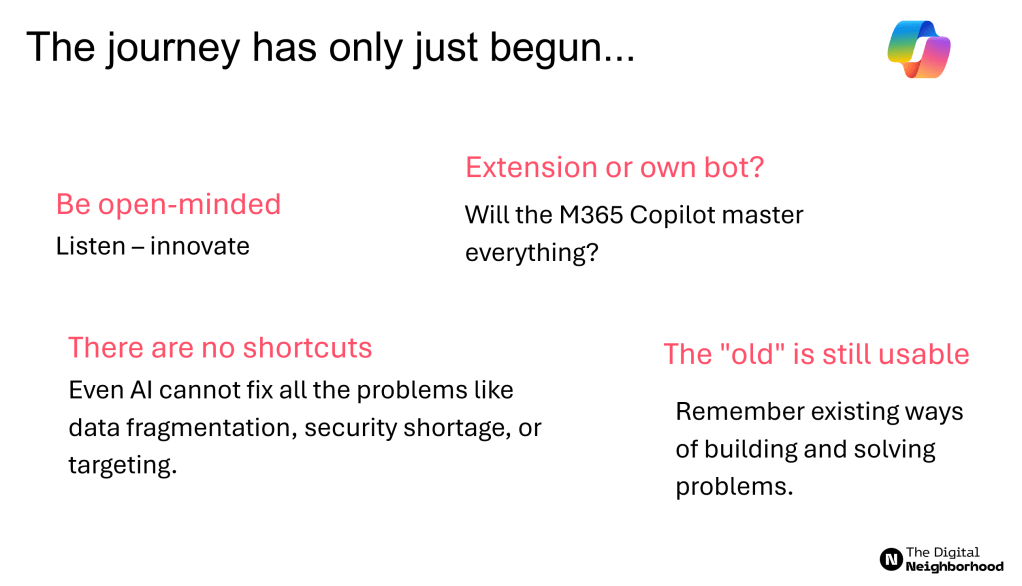
A few months ago, I spoke at the CollabDays Helsinki event about Copilot extensions & their possibilities (https://www.collabdays.org/2024-finland/schedule/). The image of this article is from that presentation, and its message is still valid for 2025.

AI agents promise to transform businesses, and they will, but companies must address foundational issues like infrastructure, integration, and security to unlock their potential. You should also rethink your ways of doing and leverage existing capabilities and tools. You can benefit significantly from process automation, small targeted applications, and small-scale AI capabilities.
Most importantly, listen to your employees, discuss things with them, and hear what they need. You should also train the organization to use existing and new tools efficiently. Using AI tools requires a new mindset and way of thinking, and we must step away from googling to discussing.
That sounds easy, but experience has shown that the need for change is more remarkable than imagined. This is why I’m so excited for 2025. And our CAS service team promises to help as many as I can in the journey.




 Mikko Koskinen
Leave a comment